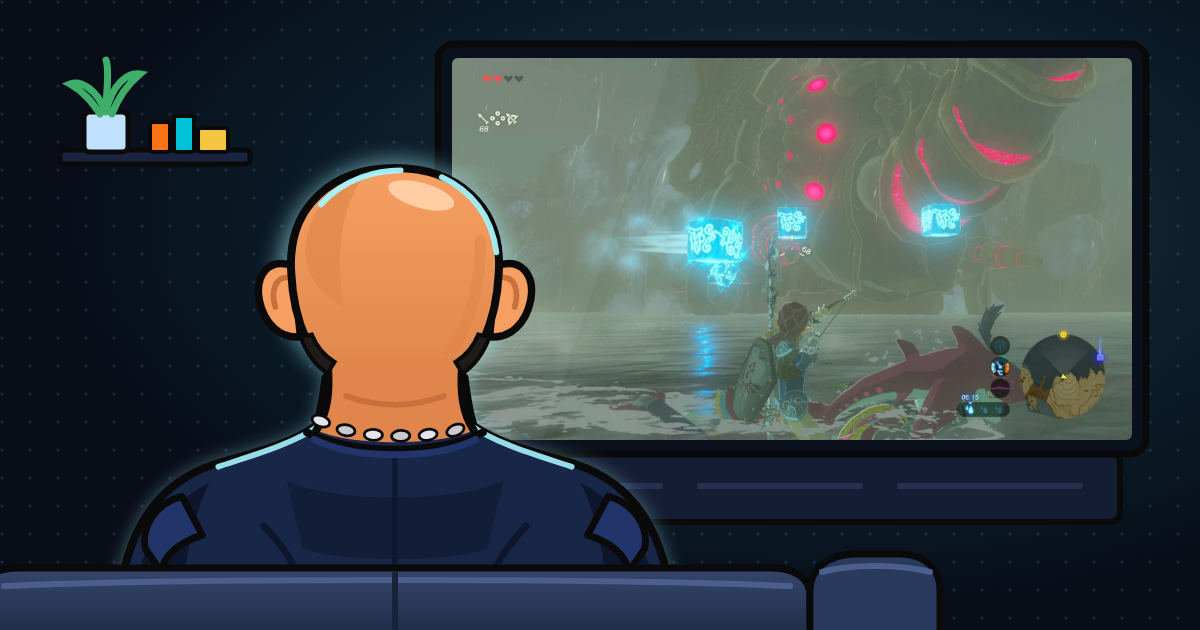
I'd played Zelda before, but mostly just to play. I had it on the Super Nintendo, on the Nintendo DS, and Ocarina of Time on the N64. Now, a bit older, I play with a different head. I got a Nintendo Switch 2 for Father's Day, and the first game I put in it was Breath of the Wild.
There's a moment at the start that sums up the whole game, and it's still one of my favorites. Link wakes up, walks out of the shrine, the camera pulls back and shows all of Hyrule in front of you. It's a huge world waiting to be explored. Far in the distance there's the castle, with a dark cloud swirling around it. That's where the final boss is.
And the game doesn't stop you from going. Once you leave the Great Plateau, you can walk straight to the castle and face Ganon with three hearts and a tree branch. You'll probably die. But you can.
The message is clear from the first minute: nobody here is going to hold your hand.
What the game stops doing
The Zelda games I'd played followed a well-known structure: you enter the dungeon, get the item, and the item opens the way to the next area. Lock and key. It works really well, but you almost always know where you're supposed to be.
Breath of the Wild hands you almost every tool on the Great Plateau, in the first hour: a magnet, bombs, stopping time, making ice blocks. After that, what holds you back isn't a missing item. It's stamina for climbing, the cold, the heat, and not having the nerve to face that Lynel.
The map doesn't come filled in. You climb a tower, look around and mark whatever caught your eye. The game gives you stamps to mark the map, not a to-do list.
Curiosity as the reward
The smartest thing the game does is turn curiosity into its own reward.
You see something odd on the horizon and head over. On the way, something else shows up. When you get there, there's a shrine, or a Korok hiding under a rock, or just a nice view. Sometimes there's nothing, and that's fine, because on the way you already got distracted by three other things.
None of this is an accident. The Nintendo team talked about these choices at GDC 2017, in the talk Change and Constant: Breaking Conventions with The Legend of Zelda: Breath of the Wild. In a later presentation at CEDEC, they explained the triangle rule: triangle-shaped mountains and hills hide what's behind them, and that makes you want to climb up and see.
It's a way to guide the player without saying where to go. The terrain does the job that other games give to an arrow in the corner of the screen.
The chemistry
The other pillar is what the team called multiplicative gameplay. Instead of every puzzle having one solution designed up front, the game has simple rules that combine: fire burns grass; burning grass creates a hot updraft; the updraft lifts you with the paraglider. Metal conducts electricity. Ice slides. Wood floats.
The fun part is that the solutions you come up with actually work. Freezing water to cross a river, freezing a tree in time and whacking it until it launches with you along for the ride, sliding down a mountain using your shield as a board.
The other moment that stuck with me was the first Divine Beast: a giant machine that is, as a whole, one big puzzle, with parts you move around to solve the challenges inside.
Letting the player get lost
The game's bravest choice is the one in the title: trusting that the player will want to explore.
And I got lost a lot. When Link wakes up, you have no information at all. And the whole game stays that way: what you get are clues, never instructions.
Most big games are afraid the player will get lost, frustrated and quit. They make up for it with markers, arrows, quest lists and a character repeating what you should be doing right now. Breath of the Wild bets that getting lost is part of the fun.
The one catch
It's not that I didn't like it, but managing the weapon inventory is a pain. Weapons break, space is limited, and a good chunk of time goes into deciding what to carry and what to drop.
Why I still think about it
This blog talks a lot about technology, and this post isn't here to draw any lesson about software. It's just a game I really like.
And that's going to be the tone around here. There'll be plenty of technology, AI, communication and leadership, but also sports, video games and family. The idea is for you to get to know Leo beyond the professional side.
Meanwhile, I'm savoring every corner of Hyrule, talking to every NPC and doing the side quests. I haven't played Tears of the Kingdom yet. The plan is to beat Ganon the day before the new Ocarina of Time comes out on Switch 2, the same Ocarina I played on the N64. Which, by the way, is already bought.