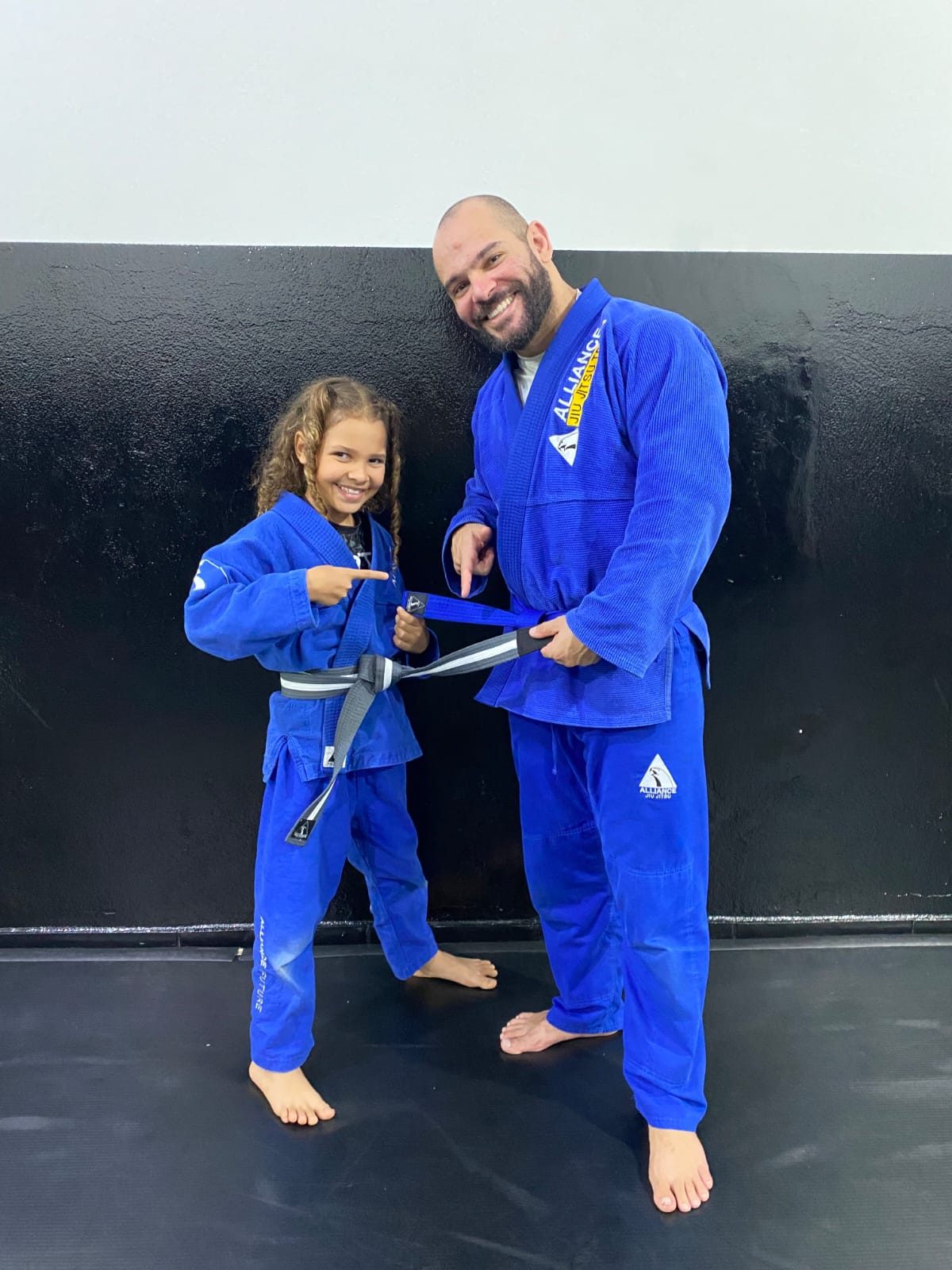
I trained Jiu-Jitsu when I was younger. I stopped because of lack of time or self-sabotage, depending on how honest I'm being that day. About a year ago, at 38, I went back. The reason was my daughter.
And I quickly learned something nobody had warned me about: going back is worse than starting.
When you start from zero, you have no expectations. When you go back, you have memories. Your head remembers that you used to know how to do this and knows exactly what should happen. Your body didn't get the memo.
There's a specific kind of discomfort in being a beginner as an adult. It's not the kid kind, where you don't know anything and that feels normal. It's the kind that hits someone who's already good at other things, already has a career, is already the person people ask when it comes to their field, and suddenly has no idea what's going on.
In Jiu-Jitsu, that discomfort is physical: someone pins you to the mat and you have no clue where to even start getting out.
Going back to the mat required something I hadn't allowed myself in a long time: permission to be bad at something.
White belt
The white belt is the start of a long road. Getting to black belt takes eight to ten years on average, and there are no shortcuts: rank comes with mat time.
The first classes follow a pretty predictable script. During the technique part, you drill the position, repeat it, understand it and feel almost competent. Then sparring starts (in Brazil we call it rola), and everything that made sense ten minutes earlier is gone. You spend twenty minutes getting smashed by everyone, one at a time, very politely.
And the next day you're back.
For those who don't train: when you get submitted, you tap, a few quick taps on your opponent or the mat, and the round stops. Nobody gets hurt, nobody thinks it's weird. It's part of it.
At first you tap a lot. A lot. Several times a minute. Some days it feels like you only showed up to practice tapping.
Until one day you hold out a little longer. Then you get through a whole round without being submitted. And one day you walk off the mat with a new and dangerous feeling: "I think I actually controlled that round."
The 14-year-old
That feeling lasts until the next round puts you back in your place.
Mine was against a 14-year-old kid. I was about to get my blue belt. It felt like my first class: I had no idea what was happening. He, apparently, knew exactly what was happening.
Ego
Losing to someone bigger and stronger is easy to accept. Losing to someone smaller who doesn't even seem to be sweating hits differently. Your body knows it lost. Your ego goes looking for excuses: "I was tired," "he's been training for years," "in a real fight it'd be different."
When your opponent is 14, you run out of excuses pretty fast.
Over time you lose less, but you keep losing. What changes is how you relate to losing. Tapping stops being embarrassing and becomes information: that arm was exposed, I stayed too long in that position, I thought I had controlled the round.
What keeps me coming back
These days Jiu-Jitsu is my mental recovery. It's when I stop thinking about work and problems and finally get my head quiet.
That's not discipline on my part. It's just hard to think about your to-do list when someone is trying to take your arm home with them.
Permission to be bad
I'm not going to write "5 things Jiu-Jitsu taught me about leadership" here. Jiu-Jitsu is something else, and it's good precisely because it's something else.
What it does is train me, every week, to be resilient. And a phrase my brother Everaldo taught me and marked me forever: "you can always be a white belt at something, as long as you let yourself be bad at it for a while".
Today I'm a blue belt and I train three times a week. The mat became my time to quiet my head. It also became something I share with my daughter, who's the reason I came back and who trains too.
We got promoted together.